At its core, administration is a devotional art. I do it, not because I like forwarding several people the same email over and over again, but because I love service. It pleases me to be of use to you. I recall as a child being brought to my knees at the altar of Christ, and for years, I would not learn any way to love other than worship. Believing in God teaches you a debased, servile love.
Missing now, my One God of All Things, I have fractured my life into services of smaller, meeker gods: my lovers, my friends, my work, my neighborhood. They’re more like Greek and Hindu gods who lose themselves to human weaknesses like rage, ego, even simple helplessness.
For example, at the corner shrine at Ishita’s house, Ishita’s mother shows me how she gently washes and clothes the God Krishna. We remove his little crown, his little scepter, we take off his tiny, ornate green robe. I asked her why we are changing his clothes, and she says he needs help with this type of thing because he is a baby. Figure that: a god that is a baby, who needs help getting dressed. I pick up a new robe for him (this one is pink, and has a flattering gold trim). I slowly pour water down his head and into his lap where his legs are crossed. Ishita’s mom is wincing a little because I have picked up Krishna by the head, which is a rude thing to do to a baby and even ruder to a god – a rude thing indeed to do to anyone. I gently support him with my other hand, and consider his cold brass weight in my palm.
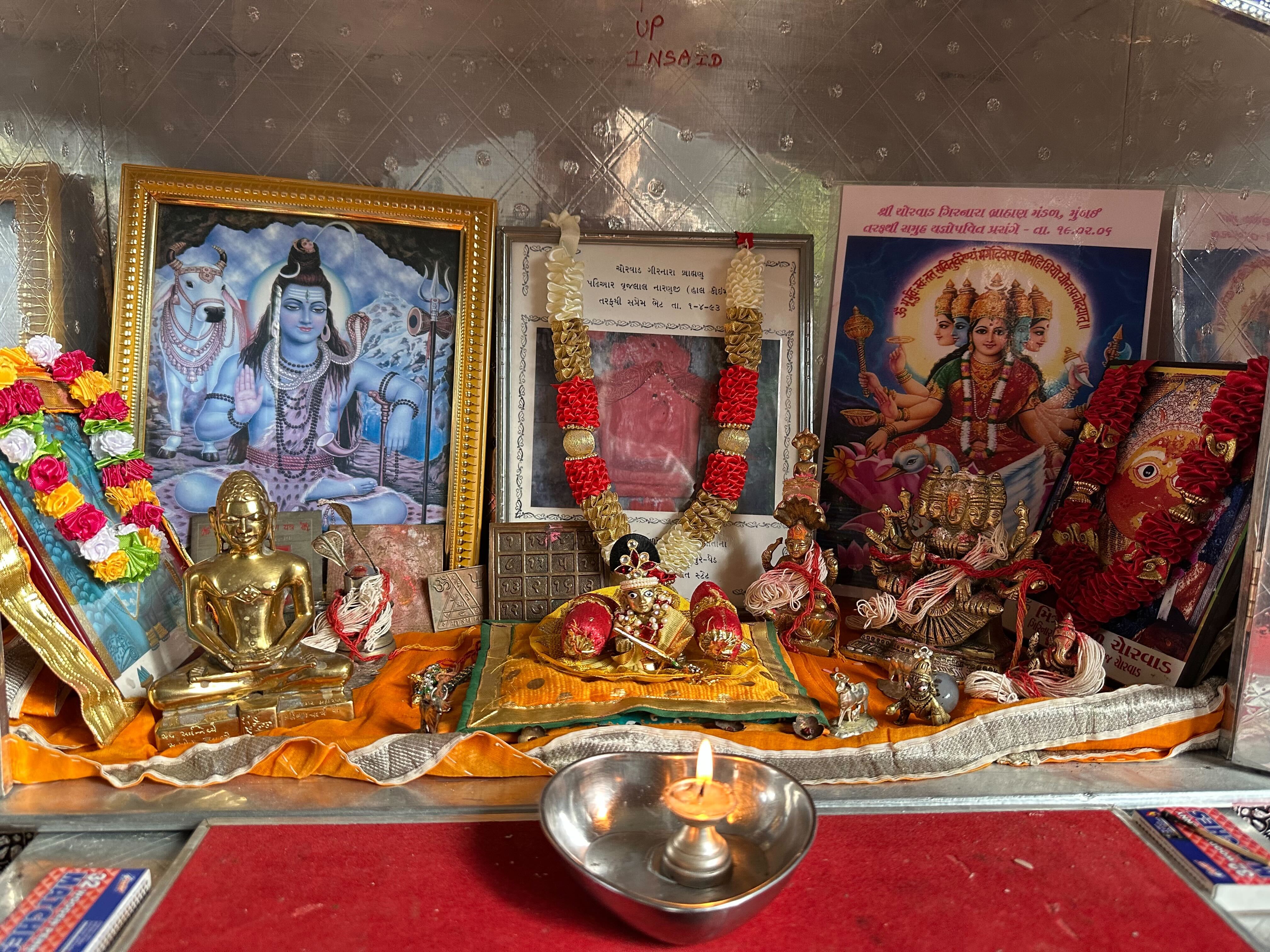
With the same care, I make dinner for my two roommates: Ishita and Leighann, sister gods of their limited domain in our apartment. In my imagination, our house is the temple served by a younger, weaker human fellow (me), more prone to forgetting to wash my dishes or eating my food before it rots in the fridge. They lovingly forgive these sins and make a chore chart to guide my worship. I clean the floors with a rag on my knees, working across the kitchen in little bows of effort. Bow, push, clean, scoot. Again.
Ishita is messy too: a funny little slob-god. Ishita explained to me once that she carefully uses her “tough love” passes to protect me from harm – an intelligent god, she, who knows her followers are stubborn and may take some time to understand the truth. Leighann is like the Old testament God, strict and quick to temper. She can’t listen to my dating exploits because she is maddened by the careless ways they hurt me, and the careful ways I hurt myself. She watches me put on my shoes in the kitchen, and good-naturedly allows me to joke my way to forgiveness, even though I know she is disgusted by this. “Cleaning day is tomorrow” I say, cheeky me. I love them both devotionally.
One day, wanting to know the texture of Leighann’s hair, I ran my fingers through it at the base near the heat of her skull. I was a little surprised she allowed me to do this, and it reminded me of when I realized for the first time that those little wafers we ate in church were the body of Christ. How he loved us, to let us trespass His intimacies so.
At first, I thought 8 Ball was a god too. I could not understand any other reason for such a bright group of people to be allegiant to a wailing spirit, by all means appearing to draw its life force from their very own blood. By the time I had joined, the organization had lost grip of its own inertia, and seemed to me, prepared to crumble at the loss of any single significant member. They did not write anything down! They did not double up their critical domain knowledge. It was a severely understaffed shamble of inconsistent systems skating hot on the fuel of pure affection. The best were burning out, and the worst, I think were already gone. The first admin meeting I went to was a financial crisis meeting. Very somber. Very long. They seemed to blink in slow motion.
Also, they didn’t call the office a church, but they call it “the space” which semantically also seems somewhat mystic and religious. 8 Ball, I thought, was a flawed, helpless god of an even more limited domain at 1 East Broadway. Another of these lesser gods, weak especially to chaos, and a shocking lack of historicity (documentation). Gods who lack a past tend also to lack a future. The parishioners seemed tired above all else. I could see that the need for administrative (organizational) work was great. This was fantastic news for me. I am excellent at admin.
In fact, I have several symptoms of a person well-bred to engage in systems of labor: default obedience, natural fealty to authority figures, and a desire to gain the approval of others. It turns out that living in a monotheistic religion as a child was the perfect training simulation to become a good, docile employee in adulthood. I for one, am an excellent employee, even though I no longer believe in my old God.
So I administrated. I wrote things down, sent emails, all that boring, necessary stuff – detritus of any collective human effort. I was sometimes sad to see how useful I had become through my corporate training, but structural efficiency is actually one strength of profit-mongering. And though I was worried I would taint the personality of the beast while trying to strengthen it, if I am a capitalist, I might as well put it to use, I thought. Just look how well I serve, impressed and disgusted at myself.
But slowly, over time, this work changed me.
Once, I watched Gilad explain, “the best thing about 8 Ball is that there’s nothing to steal. If you really got all the way into the bank account, what would you do with five thousand dollars? It’s not enough to change your life.” It’s true, this temple is shabby: the bank account is constantly in famine, the posters are always sagging. The humiliations of constantly living at the mercy of generous strangers are physically manifest all around us. If ever Tauba decides to stop giving us 275 dollars a month, we’re screwed actually.
Why bother to bath and cloth this thing so weak it cannot even stand on its own? I thought of this question as I washed the little baby Krishna. I returned his scepter. I returned his crown. I placed him on his little velvet cushion, plush and shimmering in his gown.
When Ishita’s mom left to check on dinner, I gave him a quick stroke down the cheek with my pinkie. I don’t know if it’s appropriate to stroke a God’s chubby baby cheek. (The only other God I had known let me drink his blood in a brutal ritual they called communion, so He did not teach me appropriate relations.) All babies are like small gods we wash and cloth. They receive our devotion and servitude before they have committed any single conscious act of goodness or badness at all. We don’t love things because they are deserving of our love. It is a question wrongly posed: Why we love, why we worship. Why raise funds for a dying thing? This helpless thing not even worth robbing? Why learn guitar if I’ll never get good? Why write poetry that will not change the world? Why record cassettes and zines and other withering arts? Why continue loving at all? All these questions…wrongly posed. They do not reveal truths.
Instead, consider this. Leighann peels her fruit at the dinner table with one leg propped up, the knife closely controlled between her thumb and pointer finger. If I linger politely in the kitchen, she will always look up and ask if I would like a piece. Do you know how it feels to be offered fruit by your own God? Giving service, the act of worship, this aggravates the same instinct as receiving it. Serving and being served, loving and being loved. Rising to kiss God, then descending again to join the ranks of his devotees, returning his scepter, stroking his cheek. Turning and turning in a spiral constantly returning to its own core, we are made divine both in peeling the fruit, and in eating it from her hand, because she peels it for me, and I eat it for her. I serve my god, who serves me.
So you see, the greater truth revealed is the bending nature of every Earth-creature, made godly by devotion. It is a fact of nature: you cannot be loved and remain just human. To be worshipped, at some point, is to be imagined into apotheosis. And to be loved further is to be known and known back down to Earth. If my devotion creates my God, then I myself am godly in my creation. I am the God that creates gods. All us lovers are gods in this way, transcending, descending, oscillating gently between mortality and immortality all the time, against our own will it seems. We are all living. And at the same time, every baby begins to die as soon as it is born. What do gods like us do with our time on Earth? Send emails? Coordinate group chats over Slack?
Well, yes. We have meetings to discuss this very zine, which is to say, to discuss what matters to us, what information we would like to distribute to others. We make schedules to relieve each other our burdens, and to distribute the work of serving. We make time to gather round and decide which beautiful things are worth making, and which horrible things are worth fighting. We serve each other before we have proven that we are worthy, and we serve each other up to worthiness. Look, see what I have made for you? Do you like it? Does it please you? See how I kneel, and how I worship? Will you kneel too? Will you meet me down here in servitude? I am waiting. Down here there is something important I would like you to know. 8 Ball is not a god. 8 Ball is more like an animal. It breathes. It dies. It is constantly dying. 8Ball dies for the same reason it lives: We are the Gods here, and only our love sustains it, just as only love sustains every animal on Earth.