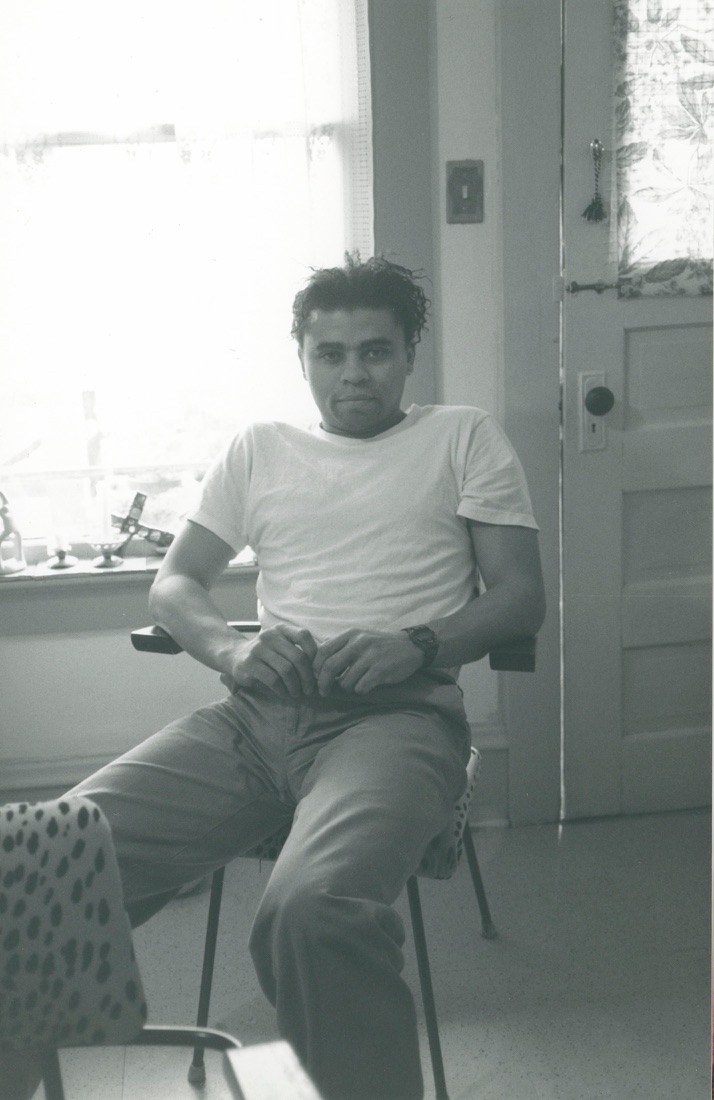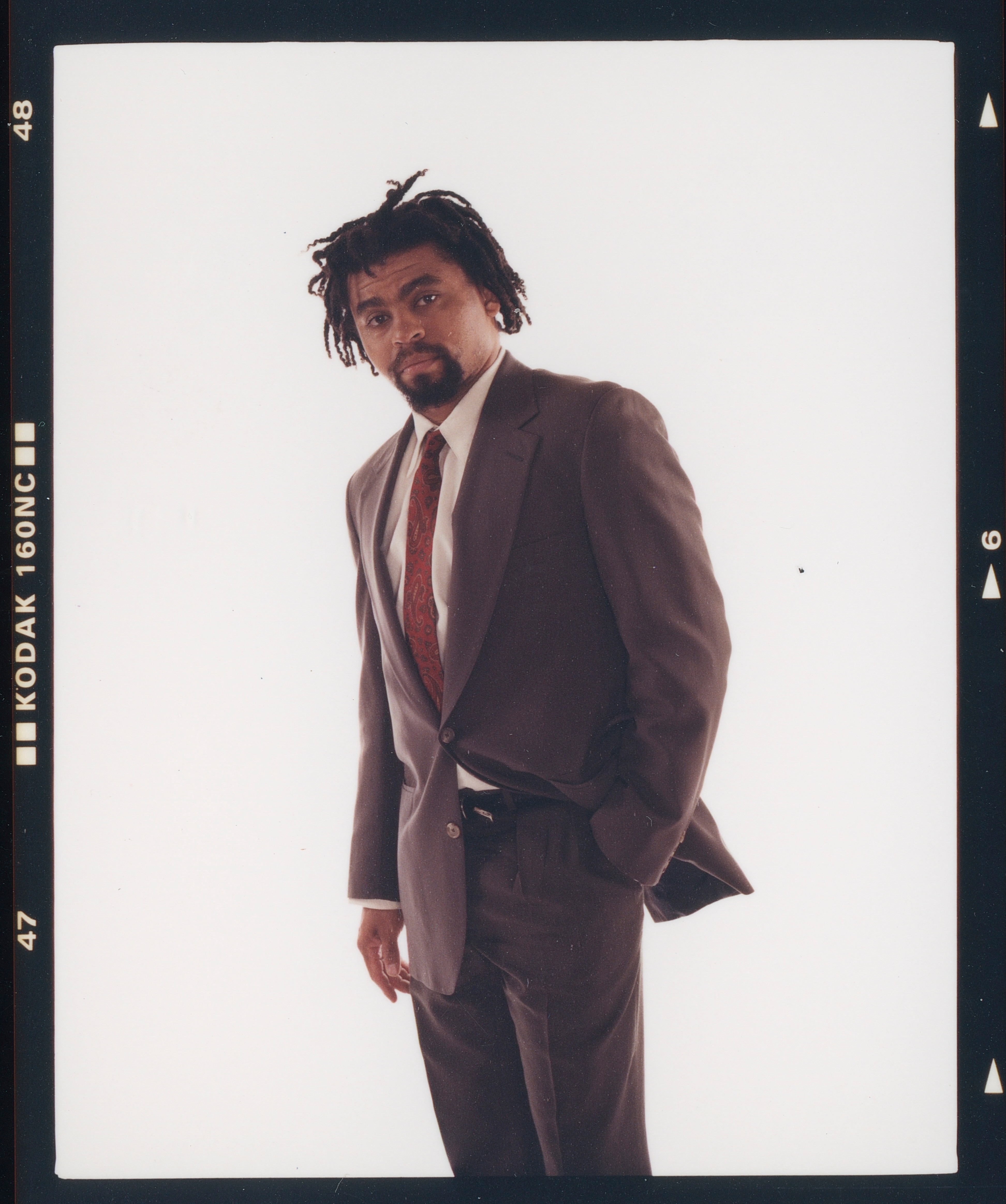
Born in Wichita Kansas to a dark-skinned black father and a light-skinned, mixed-race mother, my father would always be influenced by this mixed heritage. On the day of his birth there was some confusion on the subject. Soon after he emerged my grandfather arrived asking about his baby boy. He was told there’d been no colored children born that day. Arthur insisted, (he worked at the hospital) he had been paged with news that his son, Kevin, had just arrived. A look of recognition came across the nurse’s face and he was then lead to the nursery reserved for white children. There on the other side of the glass was my father, with light skin and red hair, and the name “Kevin” on his crib. I can imagine the thoughts that may have gone through my Grandfather’s head in that moment, but the child was his. Eventually Kevin’s skin would mature to a light-mocha brown. His hair would grow jet black, but in the early years of childhood he would retain the nickname “Red.” He grew up in a relatively affluent white neighborhood (they were the only black family around) near Wichita State University, where my Grandmother was a professor and a counselor. My grandfather, a chemist and a teacher, died of pancreatic cancer when my father was just ten, leaving my grandmother and the four kids (my dad, his younger sister, Kiersten, his older sister, Beryl, his eldest brother, James aka “Jimmy”) behind. It was clear early on that God had created my dad on a busy day and forgot to put fear in his heart.
My aunt likes to tell me of the time(s) she saw him climb up onto the roof of the house in nothing but his underwear and his favorite red cowboy boots. They would also spend long hours in Fairmount park across the street, skating, biking, getting into fights. Many of the stories from their youth began or ended at that park. It was like an extension of the family’s front yard, and the Spencer children treated it like their very own Kingdom. I always loved hearing stories of my dad’s childhood. They were not all fairy tales, but they all had an air of something magical about them. They all seemed to take place in a world totally unlike my own. A world full of danger perhaps, but also possibility, where grand adventures could really take place. Through their telling, the park became, for me, a sort of mythical place. Many years later I would visit that same park with my dad. It was autumn. We stood on cracked blacktop, basketball in hand, craning our necks to watch a great procession of black birds ribbon across the sky. It felt like we stood there motionless for an hour or more without saying anything. It was the first time I really thought about my dad as a child. I felt what it must have been like to grow up in Wichita. This place with no hills and no sea. This place with tornados and endless fields of wheat. This place where the sky was so big, you could watch birds soar all the way from one horizon to the other, an unbroken band of black wings.
Fully grown, he was 5’9 with a lean, athletic build. Broad shoulders and a narrow waist. He had thick black hair which, for years, he wore in dreadlocks that fell to his shoulders. (I always loved his dreads. I cried when he cut them.) He had thick eyebrows too and a broad nose. He was quick to smile or laugh, a twinkle flashing in his golden brown eyes. Always cracking jokes, usually off color. He was the consummate performer, he always knew how to play to his audience. And everyone was his audience. We couldn’t go anywhere without him striking up a conversation with somebody. Whether it was someone he knew (and he seemed to know virtually everyone) or a complete stranger. Everywhere he went he made friends. I remember finding this irritating at the time. Every trip to the bank or the grocery store had the potential to consume the whole afternoon. Sometimes I’d listen, knowing that I might be required to chime in. Often my eyes would glaze over as I’d listen to the Charlie Brown wah wah wah of the adults carrying on, tuning out his voice the way you do any sound you hear constantly. But looking back it was quite endearing. The truth is that he simply had a zest for life. He wanted to be enmeshed in the world, connected to the people around him. And people loved him. He had a quick wit and a natural ability to improvise. A creativity which flowed effortlessly. He had a huge heart and was compassionate and caring. I’ve never met anyone so willing to help other’s in a pinch. I can remember many times when he leapt into action to come to the aid of a complete stranger. I remember once, in a dark movie theatre, he recognized that the person in front of us was having a seizure and clambered over the chairs to keep them from harming themselves in their convulsions. Another time there was a bad car accident outside our apartment in the middle of the night. One of the cars flipped completely onto it’s roof. My dad rushed outside to pull the driver out of their overturned vehicle. He always had time for people, and he was absolutely ride or die when it came to his family. If you really needed him he would be there faster than you could blink.
He had a bit of an angry streak in him too though. I think this had a lot to do with having grown up without a father. His passion and his zest could turn sour quickly, if he was upset. As a young man he got into a lot of fights. He fought black kids who called him an Uncle Tom, and white kids who called him darky and worse. He fought when they called him a fairy for dancing. He fought a whole football team. He tempered this instinct slightly after some brushes with the law, but he never quite lost that edge. He would often complain about our propensity for gun violence in America, opining that people were too pussy to knuckle up and fight. The true, terrifying force of this anger was never really directed at me, but it was something to witness. A scowl would roll across his brow like a low pressure front before a tornado. The air around him became charged with static. It was enough to make me wary of ever pissing him off. I remember we got into a bad car accident once, I was about 4 or 5. We were on our way to a movie and some guy in a red sports car sped through an intersection, hitting us. The guys car actually got more fucked up than ours, and he was pinned in his drivers seat. After checking to see if I was ok, my dad stalked over to the guy and told him that if it turned out there was a single hair out of place on my head he would come back and beat him to death. When the police showed up they made my dad sit on his hands, away from the scene. Probably some racist shit. But, given the circumstances, maybe not totally unwarranted. Road rage was liable to make this kind of anger flare up, but on the everyday level he could be somewhat demanding, somewhat harsh.
Something small might set him off, spilling a glass of juice or wearing shoes in the house. If I really messed up he might grab me by the ear to show his dissatisfaction. It was never really painful but it was aversive enough to make me cautious. Any directions he gave, he expected them to be carried out after the first telling. He hated repeating himself. He hated stupid questions. He was constantly telling me to “let observation be your guide.” In the typical male way I think he was trying to toughen me up, prepare me for the real world. He methods were a little atypical though. He wanted me to be sharp, and well rounded. He would make me read aloud to him while he cooked dinner, magazines, credit card statements, screen plays, Spanish language literature, didn’t matter. I came with him to countless errands and appointments, he would leave me in the waiting area or the car with a book and the expectation that I would have notes on what I read when he returned. He taught me things, protocols on how to behave in certain situations. Never sit with your back to the door if you can help it. Always know where all the exits are. Never posture before a fight. Never let them swing first. Never have more than two drinks on a night out. Never speak loud enough to be overheard in public. What to do if someones following you. What to say (or not to say) when talking to the police. He was a strange combination of hippy and drill sergeant, artist and warrior. But he wasn’t always the most put together.
He was chronically running late to everything. Work, doctor’s appointments, picking me up from school. Somehow people always forgave him this lateness, he’d established the expectation so firmly. He was also a bit of a fibber, a bit of a shiner-on. Being the consummate performer, he was quite an able fabricator of truths. Generously, you might say he was an embellisher, a prevaricator, but sometimes he did invent things whole cloth. Mostly he lied to get people off his back, to prevent various girlfriends from finding out about each other, to stay in peoples good graces. He always let me in on his schemes though. Perhaps it was not appropriate to turn his child into his accomplice, but one needs allies. He had a way of making things seem like it was us against the world. We were like partners in crime. He was always bouncing his ideas off me, genuinely asking for my input or thoughts. He was brilliantly creative but he had trouble following through on his ideas. He was a dreamer. Around the house there were stacks and stacks of half-finished books and half-used legal pads. Magazines and newspapers piled here and there, photos and articles cut out and stuck to the fridge. National Geographic or The Stranger or WIRED.
The house was always a mess, but never dirty. At least not until the end. He liked to collect things. Some practical, some less so. CDs and DVDs, globes, boardgames, exercise equipment, kites, Hot Wheels, random shit. If you let him tell it there was always a method to the madness. Most people who saw the place probably chalked it up to an artist’s eccentricity. My mom had a different point of view. Let her tell it and the man was positively fanatical about his mess. It was arranged just the way he liked it and moreover he didn’t want people going through his shit. I’m sure this need for control played a role in my parents separation. I always thought they were a funny pair, could never quite understand how they became attached in the first place. To me they were like the sun and the moon, intimately connected somehow, but at the same time polar opposites. An improbable arrangement brought about by luck or by providence. They were both creative in their own way, my mom simply never learned to channel it like my dad did. That’s pretty much where their similarities end. He was midwestern, she was a city girl. She’d grown up in a family that never talked about their feelings, he’d grown up in one where they were constantly airing things out. He was a working poor, a starving artist. She was a humbled rich girl, working class too, but she with expensive tastes and white picket fence aspirations. They always told me that they’d gotten together for the specific purpose of creating me. It seems that once this purpose was fulfilled they had little reason to remain entangled, though they would go on loving each other in their own strange ways. Still they couldn’t help butting heads. They fought about all the typical things divorced parents fight about. How much time I would spend living with each of them. Where I should be on certain holidays. And sometimes about things that were less than typical. Inevitably, I would be dragged into the conflict, forced to take sides. Neither of them was one to back down from an confrontation. As damaged as they both were, and as bitter as the conflict between them became at times, I was always aware of the fact that they were trying their best to keep things together for me. I never doubted that I was their first priority. I was 4 when they separated, I don’t remember it being particularly fraught. I was young enough, my brain plastic enough that I just accepted things the way they were, as if they always had been.
As a child I spent my weekends in the studio with my dad. He taught dance and fitness classes at several local gyms and used these as negotiating leverage to gain access to the studios for his own practice. His classes were hugely popular. His teaching style was energetic, always chirping out aphorisms and little rhymes off the top of his head. Circling the room to see his choreography from all angles. He made up many of his dances on the fly, you would never be able to tell though, they were always seamlessly integrated. He might do a whole series of classes that were variations on a theme and then round it all out with one class throwing together all the different combinations. He would incorporate jazz, funk, R&B, house, latin, whatever music was catching his ear that week or that morning. He made all his classes feel polished and held his students, even the novices, to a high standard. This gave his classes a professional feel that people were drawn to. He wasn’t the type of instructor to simply stand by and watch either. He would be dancing the combinations and shouting instructions at the top of his lungs simultaneously. He had a distinct and rhythmic way of calling out the steps, often making up rhymes or repeating motifs, like he was singing. And always dancing dancing dancing. Dancing his ass off. The motherfucker would not stand still. Even as a kid I sometimes wondered how he summoned the energy. After every class he would gather everyone around to hold hands in the middle of the room, forming a circle, the music still going at a low volume behind us. He would offer us some words. Something to think about as we went on with the rest of their week. Some specific shoutouts for the people in class, birthdays, anniversary’s, etc. And then we would all raise our hands together and take a bow. Not to an audience, but to each other. Thanking each other for our presence, our shared experience. I remember after class his shirt would be drenched in sweat. I can feel it still, hugging him after class and having to peel myself off his sweat soaked clothes. This moisture the evidence of his all-out effort. During a class he would stop for breaks only occasionally as perhaps his blood sugar dictated, and he always carried some sweet snack to boost it up. Usually some type of candy bar, a snickers or a baby ruth. Sometimes a glazed donut, maybe an orange if he was feeling healthy. At the time I never thought much of the way his behavior was shaped by his illness, but looking back it did color much of his life.
Kevin was diagnosed with type 1 diabetes at the age of 26. He got by okay for a good long while. He was young and fit, his body could still handle the beating. His biggest downfall in managing the disease was that he was extremely averse to having low blood sugar. The most common symptoms of which are shakiness, weakness, cold sweats, confusion, ravenous hunger, and if not addressed properly, eventually, loss of consciousness and death. Easy to see why one would want to avoid feeling like that, but because of that he often over corrected, maintaining overly high blood sugars in order to avoid approaching a low. Hence the ubiquity of candy bars and donuts and soda and anything else that could quickly raise his blood sugar. All of which are pretty much the exact opposite of what a diabetic should be consuming. I remember seeing him test his blood sugar, not often enough. And I remember him shooting his insulin, usually before dinner or a movie. He would stick the needle straight through his pants. Or pull up his shirt to inject it into his stomach. I feel guilty now because I never realized what a burden it was, it would take my own hospitalization and diagnosis before I had any idea what it was like. It takes an enormous amount of energy and will power. Especially being diagnosed so late in life. Your habits are so much more ingrained at that point. Not to mention how clunky and sometimes inaccurate the technology was for him at the time. (The gear is much better now.) And the inconvenience of carrying around vials of insulin and hypodermic needles. I wish I’d known more back then. I was ignorant in the way only a child can be. My father’s illness was simply a fact of daily life. It was decor, something I could see every day and never notice. If I’d been at all curious I could have helped him with his diet or with reminding him to check his blood sugar levels regularly. I was clueless. I’m sure he explained things to me at one point or another, but I don’t think it really sank in just how impactful this disease was on his body or his overall health. I had the impression, like most children, that my dad was super human. His illness was not something he liked to dwell on. I imagine he felt somewhat self-conscious about it (as I do now) and didn’t want to burden others with worry. He was happy to let everyone think he had things under control.
I was 12 or so when things started going down hill. He had a really bad flu which triggered some wonky blood sugar and cardiac related trouble. He passed out at his girlfriends house and had to be taken to the hospital. That was the one that should have put us all on notice. They told him his kidneys had been suffering because of the poor blood sugar management and that he’d have to be very careful if he wanted to keep them healthy. He came back from the hospital with a list of new feeding guidelines and tips. To his credit he was willing to accept the doctors advice, but the implementation was another story. He certainly did change several things about his diet, but still he couldn’t get away from his candy bars, his frozen juice concentrate, his sugary cereals.
For a few years, until about 2014, things seemed to cruise along, no major episodes. But then he got in the accident. A rear-end collision which really fucked up his back, required spinal surgery, and left him immobile for a while. Not something Kevin Spencer was comfortable with. They gave him enough oxycodone to supply an small pharmacy, but he gritted out the pain sober. He didn’t want to become dependent. That was the thing about my dad, he was genuinely the toughest motherfucker I’ve ever met. Anyway, that was the real beginning of the downward spiral. After the surgery he was never quite able to move like he once did. Wasn’t able to lean on exercise as a guardrail for his overall health. He was in his 50s at that point. His body was already quite a ways down the long slow decline. Hid blood sugar regulation suffered. Mentally I’m sure he was having a hard time as well. Eventually, and this was really what sealed his fate, he would have to begin kidney dialysis. Once you start dialysis you don’t stop until you get a transplant, or you die. The life expectancy at that point is 3-5 years. A transplant was not forthcoming, the list is long. And he was in a tough spot because he would have needed both a kidney and a pancreas. I agonized over whether I should give him one of my kidneys. My mom forbade it on the grounds that I might need both of mine someday, I hate that she was right. Once the writing was on the wall the decline only accelerated. Dialysis is not an easy process, it leaves you mentally foggy and physically exhausted. He started to really slow down at this point. He was less able to do things for himself, some days he couldn’t work or even summon the energy to leave the house. Food became a sort of psychological crutch. Something he could control— control poorly, if he so desired. He had a very Dostoyevskian will to self-destruction. For a man so smart and so resilient it’s hard to see it any other way. Closer to the end I would start to recognize and resent this willful decline, but I also saw that once he had reached a certain point he really was too far gone. He’d slid too far to clamber back up the slope. His boulder had rolled away and he didn’t have the will to go looking for it. It’s hard to watch someone be cut to pieces. Even harder when it’s their own doing. First it was his pinky toe. He had a puncture wound which lead to an infection that never recovered. There was only one thing for it. I remember thinking that it would be a challenge to regain his balance but that he could handle it. I had to overcome some nausea changing the bandages, but one can get used to anything. Next it was neuropathy in the fingers of his left hand. The pinky started to shrivel and curl up, his hand started to look claw-like, the flesh and the nail turning black. The surgeon did a great job with that one, you could barely see the scar. After that it was the rest of the toes on his left foot. Then it was the everything below the knee.
I think about my dad every day. There were things I wish he’d done differently. I wish he would’ve taken better care of himself. I feel like I was robbed of time we were supposed to have together. I wish he would have had his shit a little more together, so that I wouldn’t have been stressed about where he was going to live on top of the stress of his treatment. I wish I wish he would have had someone else in his life he could’ve relied on besides me. I know he was trying. But he put me in a bit of a pickle. He needed me too much, and I wasn’t ready for the responsibility. I remember one time specifically when this dawned on me. I came home to find him naked on the toilet. He’d been struggling all night with intense vomiting and brain fog due to the dialysis and his panoply of medications. I did my best to get him get cleaned up and get a shirt on him at least. When I finally got him standing up he wrapped me in a hug and started sobbing. “I’m really fucked up” he told me through the tears, “I gotta get healthy. I don’t know what I’m gonna do.” It was pretty shocking, I’d never seen my dad cry like that, like a child. I’d never seen him seem so lost. I had no idea how to respond so I just stood there embracing him and we cried together. At that point I knew that our roles had reversed and I would now be the one taking care of him. I know what it’s like to really feel needed, and to feel like I haven’t done enough, couldn’t possibly do enough. It’s funny, when he was still here I resented him for all these things he could’ve done differently, but now that he’s gone none of that matters. He used to call me constantly from the hospital, or the rehab center, asking for this or that. He might need me to handle something, paperwork, talking to the Doctor or a social worker. He usually wanted me to bring him some food, Dominos or Taco Time. Sometimes he’d just want to chat. I came to dread these calls, they reminded me of all that I wasn’t able to do for him. At times I felt like I’d collapse from the pressure, like I’d simply become a puddle of tears. Answering, I’d be crushed under the weight of my responsibility. Rejecting the call, I’d be eaten alive by my guilt and anxiety. There were many times when I’d just watch the phone ring and cry. What I wouldn’t give now to receive just one phone call from him. All I have now are voicemails. I’m so grateful to have saved them. They run the gamut from simple greetings to extended monologues on philosophy, culture, or current affairs, soliloquies of his hopes and dreams for the future, requests for pizza.